

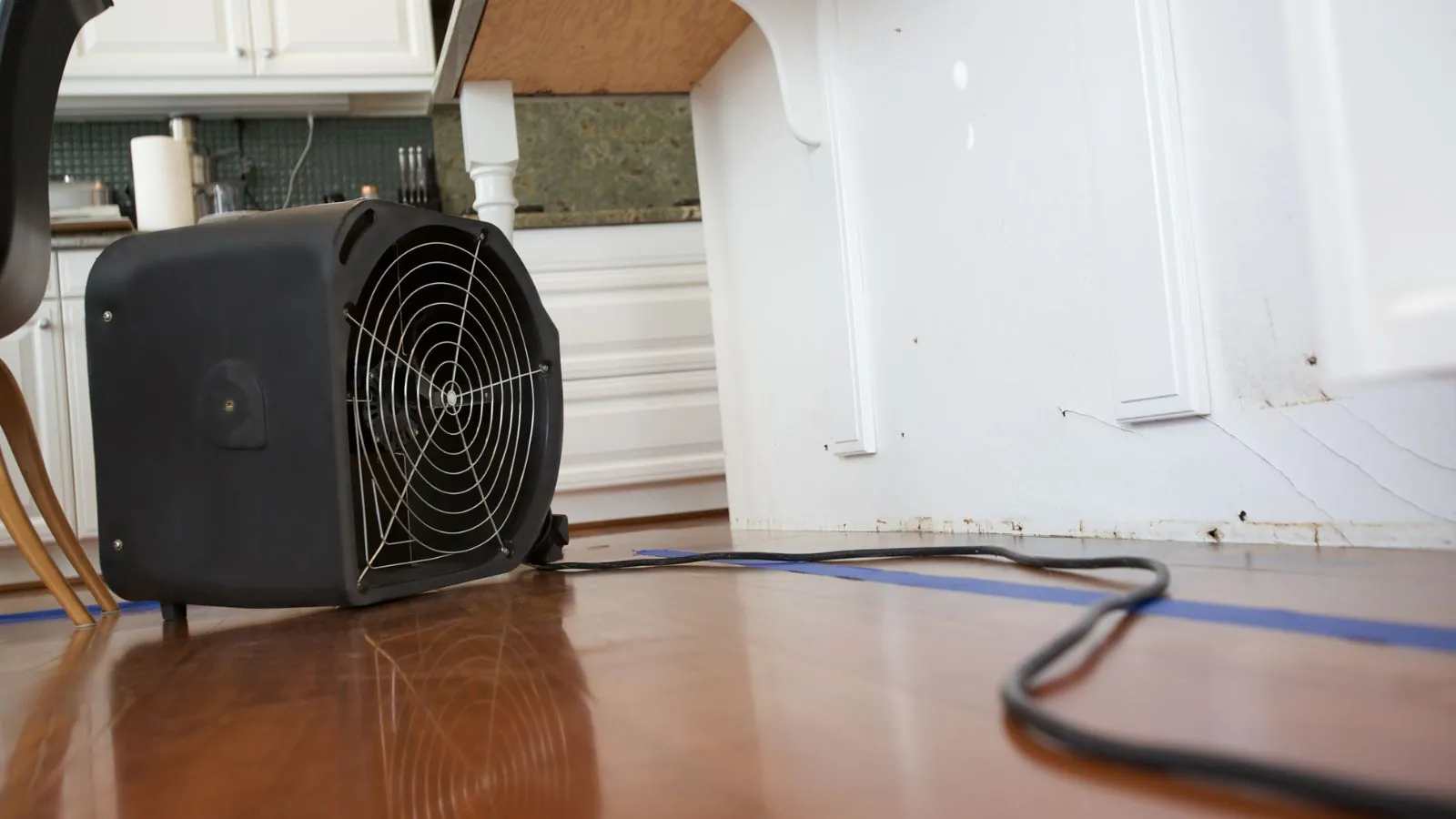
Kitchen water damage restoration is about the room, not the source. Whatever leaked, the kitchen has features that hold water: cabinet boxes sitting on the floor, a closed sink base, layers of flooring and a wall full of plumbing. In Grandview, MO, crews dry those hidden spaces and repair or replace what cannot be kept.
Most kitchen damage is found late. A slow drip under the sink can run for months behind the cleaning supplies before the cabinet floor gives way.
Signs of Water Damage in a Kitchen
- A cabinet floor under the sink that feels soft or has swollen and split
- Toe kicks that are stained, bubbling or pulling away
- Flooring that is lifting, cupping or discolored near the dishwasher or fridge
- A musty smell when you open the sink cabinet
- Dark staining or peeling at the bottom of the wall behind the sink
Water damage under a kitchen sink is the most common version. Empty the cabinet, dry what you can see and close the shutoff valves on the supply lines if anything is dripping.
What to Do Before a Crew Looks at the Kitchen
Simple, safe steps
- Close the two shutoff valves under the sink, or the main valve.
- Empty the sink cabinet and nearby drawers so air can reach the wood.
- Do not run the dishwasher or disposal until the source is known.
- Keep away from wet outlets on the backsplash and under-cabinet lighting.
Drying cabinets and subfloor is done to the ANSI/IICRC S500 standard, which is why readings, not appearance, decide what stays.
Why Cabinets Are the Hard Part
Most cabinet boxes are particleboard or MDF with a thin skin. Once the core gets wet it swells and does not shrink back. Plywood boxes and solid wood face frames cope much better.
| Cabinet material | When wet | Usual outcome |
|---|---|---|
| Particleboard or MDF box | Swells, crumbles at edges | Replace affected boxes |
| Plywood box | May stain or delaminate slightly | Often dried and kept |
| Solid wood doors and frames | May warp | Often dried and refinished |
| Laminate countertop | Substrate swells at seams | Replace if swollen |
| Stone countertop | Unaffected, but heavy to lift | Supported or removed to access cabinets |
Water damaged kitchen cabinets can sometimes be dried in place if the water was clean and it was caught in the first day or two. The crew removes toe kicks, drills small holes in hidden spots and pushes dry air through the base.
The Drying Process in a Kitchen
First the crew measures. Moisture meters check the cabinet bases, the wall behind and the floor on both sides of the cabinet run. A thermal imaging camera shows how far water travelled under the flooring.
Appliances are pulled out. Air movers are aimed under the cabinets and an LGR dehumidifier controls the room. If the wall behind the sink is wet, the back panel of the cabinet or the drywall is opened. The approach to that wall is on the wall and drywall repair page.
If the cause was a dishwasher, ice maker or disposal, the source side of the story is on the appliance leak page. A sudden split in the supply line is covered under burst pipe cleanup.
Kitchen Floors: What Is Under the Surface
Kitchens often have more than one floor layer. Tile over old vinyl over plywood is common in remodelled homes, and water gets trapped between layers. Floating laminate and vinyl plank must usually be lifted so the subfloor can dry.
Site-finished wood running under the cabinets is a special case, because removing it can mean removing cabinets. Options for wood are discussed on the hardwood floor page.
Repair Options and Honest Trade-Offs
Replacing only the damaged cabinet boxes is the least disruptive repair, but matching door style and finish on an older kitchen can be difficult. Sometimes the sink base is rebuilt in plywood and the original doors are reused.
If several boxes and the countertop are affected, a larger section may need to come out. Ask for the scope to list which pieces are being dried, which are being replaced and why.
Cost Factors and Insurance
- Number of cabinet boxes affected and their material
- Whether the countertop must be lifted
- Flooring layers and how far water travelled
- Wall damage behind the sink or dishwasher
- Days of drying equipment
A sudden leak is often covered, while a drip that went on for months is frequently excluded as gradual damage. Check your policy or ask your insurer. You see the scope and the price before a single cabinet is touched. Call (833) 521-1033 for a kitchen assessment in Grandview, Lee's Summit or Pleasant Hill.
Questions About Kitchen Water Damage in Grandview
Prefer to talk it through with a person? Call (833) 521-1033 at any hour.
Is kitchen water damage an emergency?
It is if water is still flowing. Close the valves under the sink or the main valve and call. If the damage is from a slow leak that has stopped, book an assessment soon. The phone line is open 24/7.
The cabinet under my sink is swollen. Can it be repaired?
If it is particleboard, usually not. The sink base is typically replaced or rebuilt, and the doors can often be reused. The wall and floor behind it should be checked for moisture first.
Can you dry under my cabinets without removing them?
Often, when the leak was recent and the water was clean. Toe kicks are removed and dry air is directed underneath. If readings do not fall after two days, removal is the better choice.
Do I need to worry about mold under the sink?
A long, slow leak in a closed cabinet is a likely spot for mold. If growth is visible, it should be removed with the damaged material, and the leak must be repaired first.
Will my countertop survive?
Stone tops usually do. Laminate tops swell if water reached the seams or the underside near the sink. The crew will check before any cabinet work begins.
Soft cabinet floor or lifting kitchen flooring? Get the hidden moisture measured.
☎ Call (833) 521-1033