

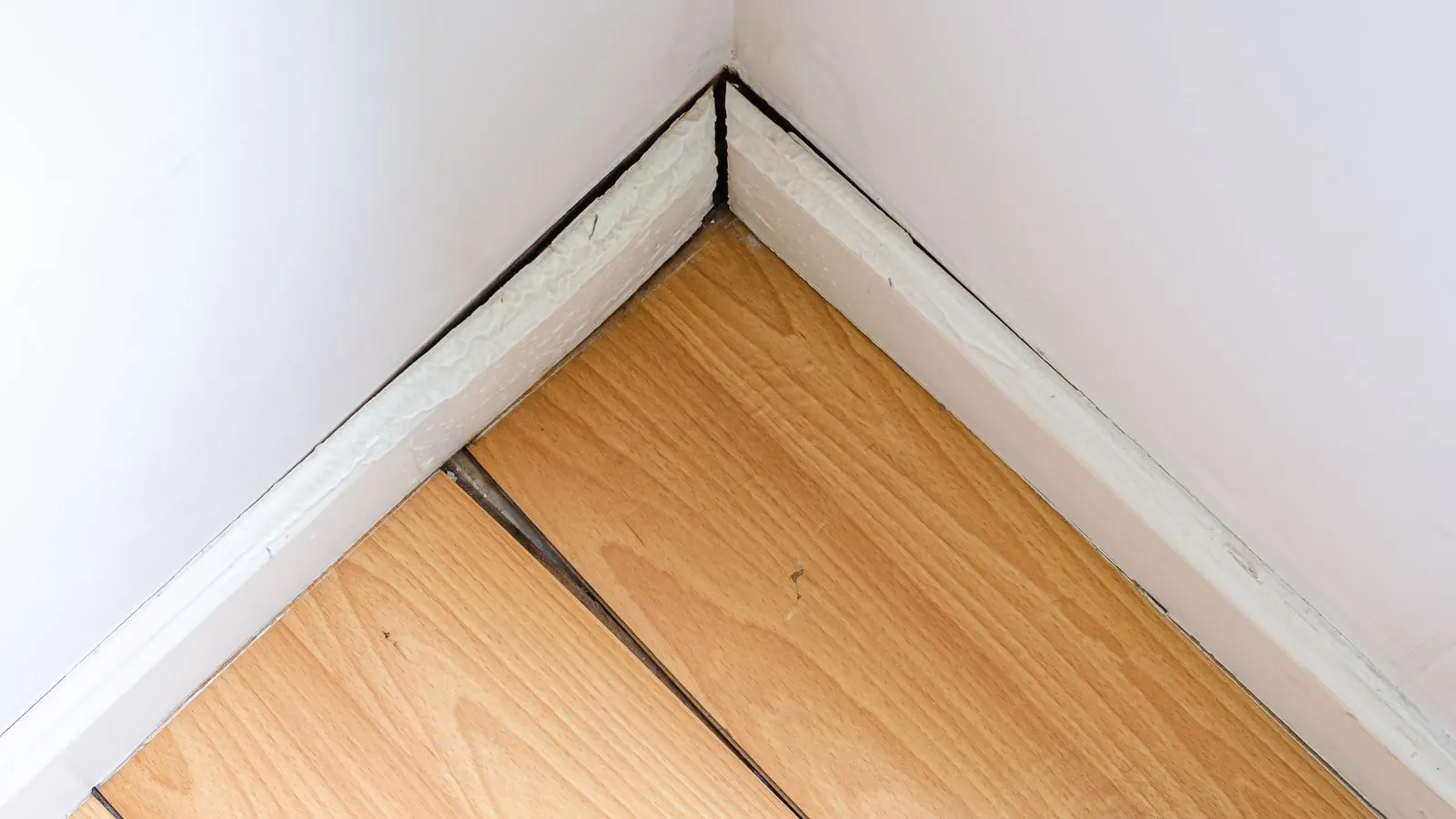
Hardwood floor water damage repair starts with patience. Wood takes on water slowly and gives it up slowly, and boards that look ruined on day two can lie nearly flat again after proper drying. In Grandview, MO, crews dry wood floors with suction mats and dehumidifiers, track the moisture content and then advise whether to sand, refinish or replace.
The same care applies to engineered wood and laminate, though those products have less tolerance for water than solid boards.
Cupping, Crowning and Buckling: Reading the Floor
| What you see | What it means | Usual path |
|---|---|---|
| Cupping: board edges higher than the center | The underside is wetter than the surface | Dry slowly, often recoverable |
| Crowning: center higher than the edges | Surface took on water, or a cupped floor was sanded too soon | Dry fully before any sanding |
| Buckling: boards lifted off the subfloor | Severe swelling with nowhere to go | Affected boards usually replaced |
| Dark staining at seams | Water sat for a long time, often with metal fasteners | Sanding may not remove it |
| Laminate edges swollen | Fiberboard core has absorbed water | Replace, it does not shrink back |
Cupping is by far the most common report. It can appear days after a spill was wiped up, because the water that matters is under the boards.
Where the Water Usually Comes From
Callers describe wood floors that began cupping with no visible spill. The cause is often a slow source nearby: an HVAC condensate line, an ice maker tube, a dishwasher seal or a washer valve that ran unnoticed.
Finding and stopping that source comes first. The pages on AC leak water damage and appliance leak cleanup explain those causes. A wet crawl space below the floor can do the same thing from underneath, as described on the crawl space page.
What to Do, and Not Do, While the Floor Is Wet
Protect the boards
- Wipe up surface water and remove wet rugs straight away.
- Do not point a heater at the floor. Fast, uneven drying cracks boards.
- Do not sand or refinish until moisture readings are back to normal.
- Run the air conditioning or a dehumidifier to keep room humidity steady.
How Wood Floors Are Dried
The crew measures the moisture content of the boards and the subfloor with a pin meter, and compares it with a dry area of the same floor. Normal indoor wood sits roughly between 6 and 9 percent. Wet boards can read 16 percent or more.
Floor drying mats are taped down over the wet area and connected to a vacuum unit that pulls air and moisture up through the seams. A dehumidifier dries the room air, and where there is access, air movers dry the subfloor from below.
This takes time, commonly one to two weeks. Rushing with too much heat can crack boards. Readings are logged every visit so you can see the numbers come down.
Refinish or Replace? The Honest Comparison
If boards return close to flat and the finish is damaged, sanding and refinishing restores the floor. That only works after the wood is back to its normal moisture content. Sanding a cupped floor while it is still wet removes the raised edges, and the boards then crown when they finish drying.
Replacement is the better choice when boards have buckled, split or stained deeply, or when the water was contaminated. New boards can be woven into the old floor, but matching species, width and color takes skill, and a full-room refinish is often needed to blend them.
Engineered Wood, Laminate and Vinyl Plank
Engineered wood has a thin hardwood layer over plywood. It tolerates brief wetting but can delaminate, and it can only be sanded once or twice. Laminate has a fiberboard core that swells for good.
Floating floors of any type trap water underneath. They are usually lifted so the subfloor can dry, and laminate is rarely reinstalled. Kitchens raise extra questions because cabinets sit on or beside the flooring, which the kitchen water damage page covers.
Older Floors in Grandview
Homes in the Grandview Residential Historic District were built from about 1905 to 1935, an era when solid strip flooring was standard. Original floors of that age are thick enough to sand several times, which makes drying and refinishing worth attempting before any talk of replacement.
Crews repair wood floors across Grandview and in nearby Lee's Summit and Pleasant Hill.
Cost Factors and Insurance
- Square footage and the type of wood product
- Days of mat drying and monitoring
- Whether boards are refinished or replaced
- Matching and blending new boards into an old floor
- Subfloor repair underneath
Sudden leaks are often covered and long-term seepage often is not. Check your policy or ask your insurer. The scope and price are explained before drying mats go down. Call (833) 521-1033 to have the floor measured.
Questions About Hardwood Floor Water Damage in Grandview
Prefer to talk it through with a person? Call (833) 521-1033 at any hour.
Is a cupped hardwood floor an emergency?
Not usually, but time matters. The sooner drying begins, the more likely the boards recover. If water is still leaking, close the valve and call right away. The line is open 24/7.
Will my cupped floor flatten out again?
Often it does, at least mostly, once the moisture content returns to normal. Severe cupping can leave a slight permanent shape that sanding corrects.
How long before the floor can be sanded?
Only after readings show the wood is back to its normal range and stable, which may be several weeks after the leak. Sanding sooner causes crowning.
My floor got wet from a washer valve that ran for hours. Can it be dried?
Possibly. Clean water caught within a day or two gives solid hardwood a fair chance. The crew will measure the boards and subfloor and tell you what the numbers suggest.
Do you replace laminate flooring?
Swollen laminate is removed so the subfloor can dry, and the scope can include replacement flooring once the subfloor is confirmed dry.
Cupping boards mean moisture underneath. Have the floor measured before it gets worse.
☎ Call (833) 521-1033