

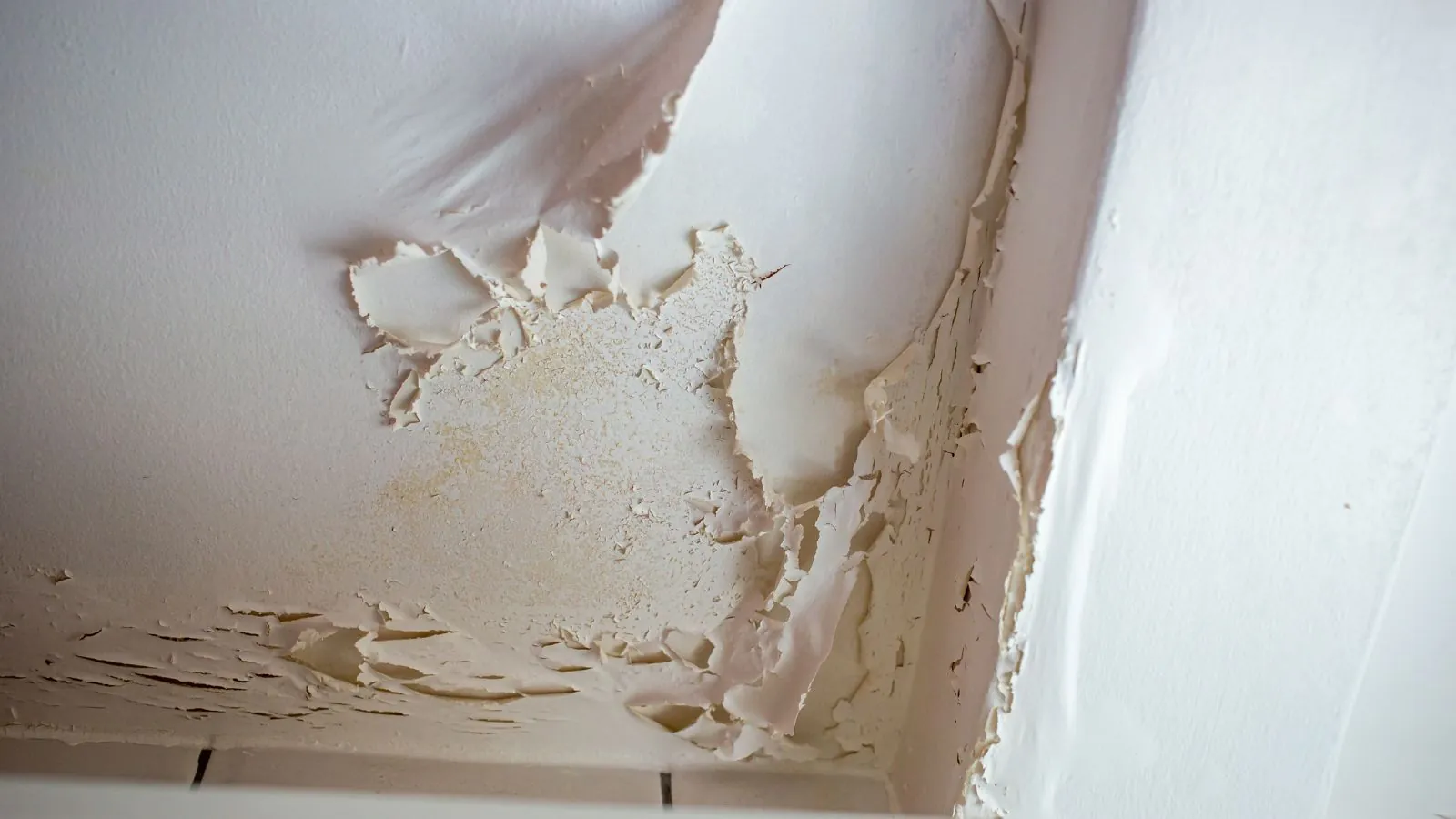
A dripping or sagging ceiling is urgent because drywall holds water like a sponge until it suddenly lets go. Ceiling water damage repair means finding what is leaking above, releasing trapped water safely, drying the cavity and rebuilding the finished ceiling. Crews serving Grandview, MO can be reached 24/7.
While you wait, move furniture and electronics out from under the wet area and put down buckets and plastic. Stay out from under any section that bulges. If water is coming through a light fixture, switch that circuit off at the panel, provided the panel is dry and safe to reach.
When a Ceiling Leak Becomes an Emergency
A faint yellow ring is a warning. A bubble in the paint, a sag between joists or water dripping from a fixture means the drywall is saturated and can drop. A collapsed ceiling in a bathroom or bedroom brings wet insulation down with it and needs a crew that day.
Do not poke a large bulge from directly below. A crew drains it in a controlled way, from the side, with the room protected.
What Is Above the Stain? Four Common Sources
| What you see | Likely source | First step |
|---|---|---|
| Stain under an upstairs bathroom | Toilet seal, tub drain or supply line | Stop using that bathroom, close its supply valves |
| Stain in a closet or hall near the attic hatch | Air handler pan or condensate line | Turn the cooling off at the thermostat |
| Stain that grows after rain | Roof, flashing or vent boot | Catch the drip and call a roofer for the roof itself |
| Wet ceiling with no rain and no bathroom above | Supply pipe in the ceiling | Close the main water valve |
Callers most often describe an upstairs toilet leaking into a finished basement or first-floor ceiling, a closet ceiling going soft, and dripping from the attic. An attic air handler is a frequent culprit in summer, and that source is explained on the AC leak water damage page.
What Not to Do Under a Wet Ceiling
For your safety
- Do not stand or sleep under a ceiling that is bulging or dripping.
- Do not use a ceiling fan or light on a wet ceiling circuit.
- Do not push on a sag to see how soft it is.
- Do not go into the attic and step between joists. Wet drywall will not hold weight.
The drying and rebuild described below follow ANSI/IICRC S500, the industry standard for water damage restoration.
Roof Leak Water Damage: The Part Under the Shingles
When the roof is the source, water has already passed through decking and attic insulation before it marks the ceiling. Roof water damage repair on the inside therefore starts in the attic. Wet insulation is lifted out, because it presses water against the drywall and loses its insulating value once matted.
The roof repair itself belongs to a roofer. A restoration crew can cover the interior, dry the attic framing and decking with air movers, and confirm with a moisture meter that the wood is dry before new insulation goes back. Water damage from a leaking roof often reaches the wall below as well, so the wall is checked in the same visit.
If the leak began with hail or wind during a storm, also read the storm water damage page, which covers openings in the building envelope and emergency covering.
How Ceilings Are Dried and Rebuilt
First, trapped water is released and the wet area is mapped with a moisture meter and thermal camera. Drywall that is still flat and firm may be dried in place with air directed above and below it. Sagging, crumbling or contaminated board is cut back to the nearest joists.
The cavity is dried with air movers and a dehumidifier, and readings are taken daily. When the framing matches a dry reference, new drywall is hung, taped, textured to match and painted. Stain-blocking primer alone is never a repair if the board above it is still damp.
Water that ran down from the ceiling usually soaks the adjoining wall and the floor beneath. Those surfaces are handled under wall and drywall repair and, for wood floors, hardwood floor repair.
Ceiling Repair Cost Factors
- Size of the wet area and whether it collapsed
- Attic insulation that must be removed and replaced
- Texture matching, which takes more labor than flat ceilings
- Drying days for the cavity and framing
- Related wall and floor damage below
Insurance often covers sudden leaks, such as a failed supply line, while long-term seepage and wear on a roof are commonly excluded. Check your policy or ask your insurer. The crew explains scope and price before work starts. Call (833) 521-1033 to have the ceiling assessed.
Ceilings in Older and Newer Grandview Homes
Homes in the Grandview Residential Historic District date from about 1905 to 1935, and houses of that age often have plaster on lath instead of drywall. Plaster tolerates brief wetting better than drywall but can separate from the lath, so it is tested by hand before anyone decides to keep it.
Later ranch and split-level homes have drywall ceilings that sag sooner. Crews repair both types across Grandview and in nearby Lee's Summit and Pleasant Hill.
Questions About Ceiling Water Damage Repair in Grandview
Prefer to talk it through with a person? Call (833) 521-1033 at any hour.
Do you handle ceiling water damage emergencies at night or on weekends in Grandview?
Yes. A ceiling that is dripping or bulging should not wait until Monday, and the line is answered 24/7. Clear the room below, stay out from under the sag and tell the dispatcher what is on the floor above.
There is a water stain on my ceiling but it is dry now. Do I still need help?
It is worth a moisture check. A dry-feeling stain can sit under wet insulation or a slow leak that returns. If readings are dry and the source is fixed, the repair may be only primer and paint.
My upstairs toilet leaked into the ceiling below. Is that contaminated?
Water from a toilet supply line is clean. Water from an overflow with waste, or from the drain side, is treated as contaminated and the wet ceiling board is removed instead of dried.
Part of my ceiling collapsed. What should I do before the crew arrives?
Keep everyone out of the room, shut off the water or the leaking fixture if you know the source, and switch off the circuit for any wet light fixtures if the panel is safe to reach. Leave the debris where it is and take photos from the doorway.
Do you repair the roof too?
No. A roofer repairs shingles, flashing and vents. Restoration crews handle the water damage inside: attic insulation, decking and framing drying, and the ceiling rebuild.
A sagging ceiling can drop without warning. Call the 24/7 line before it does.
☎ Call (833) 521-1033